The pate is over.
From Georges Foucault to Michel Caugant: the history of the haiance terrines that have transformed the presentation of food into objects of collection.
Pesquisa e curadoria: Jorge Feitosa e Fábio Garcia
Imagine abrir uma terrina em forma de pato e encontrar patê onde parecia haver uma pequena escultura. Na França do século XX, recipientes de faiança com formas de animais ajudaram a apresentar especialidades de charcutaria e, depois de vazios, continuaram a ocupar mesas e armários. O Acervo Jorge Feitosa registra terrinas GÉO em seu histórico; a pesquisa sobre Michel Caugant oferece uma comparação, sem confundir as duas empresas.
The packaging that didn't need to be discarded
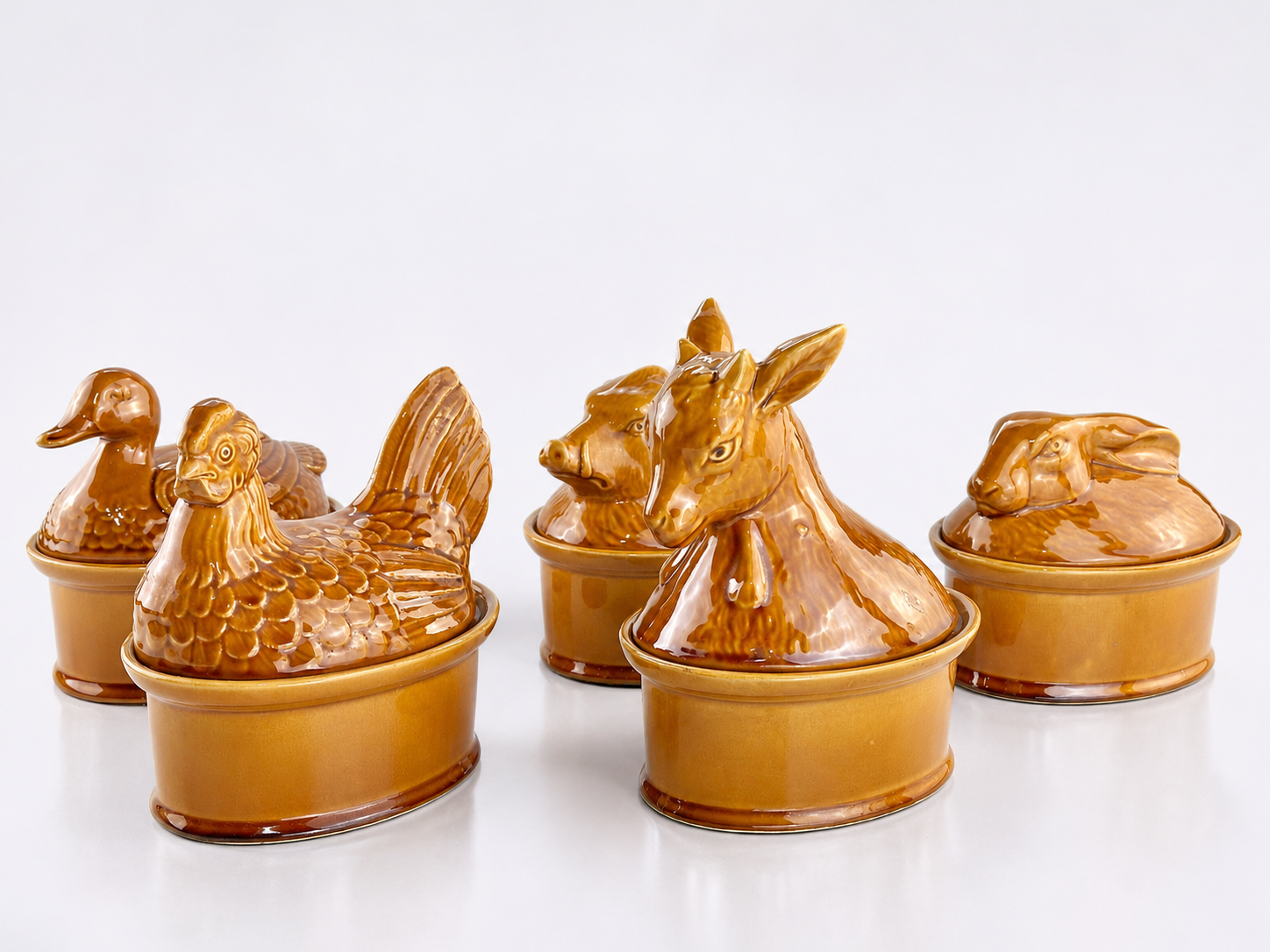
In 20th century France, some charcuterie companies sold patés in animal-shaped bean-potted terrines. Ducks, parsleys, rabbits and boars arrived at the tables as food containers and, after emptying, remained in the houses.
The animal's body hid the opening of the terrine. The duck collected the wings on the lid; rabbits and boars received modeling that accompanied the volume of the container. The glazed finish made handling easier and the figures were made suitable for the service.
The packaging was part of the commercial presentation of the food. However, its shape invited to keep it: even after the paté, there was still an object of ceramics that could return to the table or occupy a shelf.
Michel Caugant and the idea of selling the contents by the container
In Rosporden, in French Brittany, the Caugant family had maintained a charcuterie since 1927. Michel Caugant entered the business in 1956 and participated in the expansion of the company in the following decades.
With the growth of supermarkets, the presentation of products became a way to distinguish brands. In 1982, Michel Caugant began to market animal-shaped bean terrines, especially for gastronomic specialities of Christmas and hunting season.
Birds and small mammals associated the container with the culinary universe. In October 1987, Armor Magazine recorded these terrinas among the company's characteristic products. The container design was already part of the sales strategy.
From Britain to Portuguese workshops
The production of terrinas connected the French food industry to ceramic workshops. According to the specialized magazine Antiquité Brocante, the first Michel Caugant containers were made in Brittany; then part of the production went to Portugal, in the region of Fatima, for reasons of cost.
The surfaces reproduced feathers, hair, wings and eyes in relief, completed by colored glazes. Certain models refer to H. Harberstein, responsible for the modeling of parts whose molds followed for Portugal.
Other copies retain the commercial signature Michel Caugant and the Portuguese manufacturing indication. These inscriptions allow us to distinguish the company that sold the product, the professional linked to the modeling and the workshop that executed the ceramic.
GEO: another trajectory of the French charcuterie
The GEO terrines belong to another business history. In 1913, the Geo Foucault and Schweitzer establishments installed their charcuterie industry, embedded and preserved in Le Kremlin-Bicêtre, near Paris.
According to municipal records, the factory employed approximately 1,500 people and kept a cafeteria and daycare for workers. Their activity at the address ended in 1997.
GEO also used figurative ceramic containers, including examples linked to Portuguese production. Their brands identify a commercial trajectory of their own, although the choice of animal forms visually approximates their terrines to those produced for Michel Caugant.
The little beast of the table
Ducks, rabbits, boars and other animal figures have already appeared in the European table arts long before the 20th century. The paté terrinas have taken up this repertoire directly: the animal has become a lid, body and presentation of food.
The modeling needed to reconcile the representation of feathers or hair with the functional fit of the lid. Some models explored naturalistic surfaces; others, strong colors and simplified volumes. This variety encouraged the formation of sets with different animals.
The food disappears, the object remains
Those who bought a paté terrine found a food product presented in ceramics. Decades later, the same piece can be seen by the shape of the animal, the glaze and the brands preserved at the bottom.
Between these two moments, the container may have served other foods, remained in the closet or been kept as a decorative figure. Its duration exceeded that of the content for which it was manufactured.
Michel Caugant's commercial history helps explain this permanence. Interest in the container was part of the original purchase; domestic use and subsequent circulation added other chapters.
The Geo terrines in the Acervo Jorge Feitosa
The Acervo Jorge Feitosa records a set of zoomorphic GÉO terrines, associated with the Portuguese production of the 20th century, located in the catalogue of the Acervo in the second half of the 20th century. The pieces have shaped birds and mammals, with glazed in brown hues.
The integration of the lid to the body shows how each figure was adapted to the container function. The set belongs to the curatorial history of the Acervo and remains documented as part of the research on food packaging of faiance.
O conjunto permanece no histórico curatorial do Acervo, onde as formas de aves e mamíferos continuam documentadas. Os alimentos que essas terrinas um dia guardaram desapareceram; ficaram o vidrado, os encaixes das tampas e a possibilidade de reconhecer seu lugar na cultura da mesa.
Related readings
Documents and pages of the Acervo used as an editorial or in-depth basis. Do not replace catalogues of manufacturers and primary sources when required by historical identification.
- Armor Magazine, October 1987, No 213 — Report on Michel CaugantA source of time on the Caugant family business, its commercial strategy and figurative terrines. Document digitized in PDF.
- Antiquity Brocante, Editions LVA — Terrines Caugant, Florence PatrieResearch published on terrinas from 1982, the transfer of production to Portugal and the diversity of inscriptions.
- Kremlin-Bichen Prefecture — The Geo-Schweitzer factoriesMunicipal history of the company Géo Foucault and Schweitzer, installed in the city in 1913 and closed in 1997.
- The Grand-Orly Seine Bièvre — Industrial age: the company GeoInstitutional educational material documenting the industrial history of GEO in Le Kremlin-Bicêtre.
- Acervo Jorge Feitosa — GEO, Terrinas ZoomorphicasRecord the GEO set preserved in the Acervo history, used as a cover image.
- Curatorial Journal — The Golden Beast: Animals in the Decorative ArtsRelated reading about animal forms in decorative objects.
- Curatorial Journal — Why put pheasants in the middle of a dining table?Related reading about sculptures and table rituals.
Objects related to this research
GÉO · Zoomorphic Tureens
Portugal • c. 1970
Terrinas with animal-shaped caps, between birds and mammals, in brown enamel.