Sommerso: how the color began to inhabit the glass
From Murano to Bohemia and Brazil, the circulation of techniques and identities of artistic glass.
Pesquisa e curadoria: Jorge Feitosa e Fábio Garcia
Sommerso é o nome dado a uma técnica que reúne camadas de vidro de cores diferentes, criando a impressão de que a cor está suspensa dentro da peça. O efeito aparece em produções associadas a Murano, à Boêmia e a outras tradições vidreiras, inclusive brasileiras. No Acervo Jorge Feitosa, as peças vinculadas a esta pesquisa oferecem um ponto de partida visual. Identificar o lugar de fabricação, porém, exige mais que reconhecer a técnica.
In Murano, the exploration of colors involved in transparent glass became especially recognized in the 20th century. An underground vase produced in 1951 by Seguso Vetri d'Arte integrates the collection of the Corning Museum of Glass, which records Flavio Poli and Mario Pinzoni as probable authors. This documentary caution is important: without catalog or factory registration, the similarity with pieces associated with Poli does not establish authorship.
The technique requires the collection of still warm glass masses, preserving the visual distinction between layers. The optical depth depends on the thickness, geometry and incidence of light. Sommerso designates a procedure; Murano identifies a place of production. The presence of encapsulated colors, alone, does not prove Venetian origin.
Bohemia, today in the territory of the Czech Republic, developed its own glass tradition. In the post-war period, Czechoslovak manufactures worked with coloured glass coated with other layers, often described in international registers as cased glass. The works of Josef Hospodka and František Vízner, represented in museum collections, help to situate this investigation outside the Italian context.
In the Acervo Jorge Feitosa, this other tradition is represented by the table center identified as Egermann, classified as a Czech piece of the late 20th century. Its open and wavy profile and the gradation of amber explore the relationship between shape, color and light. The piece is presented here as an example of bohemian artistic glass, not as an example of the submerged technique.
In Brazil, the circulation of Italian glassware found its own production conditions. Cristals São Marcos records its foundation in 1962 in Poços de Caldas, after the transmission of knowledge by the Italian master Aldo Bonora to the Molinari brothers. Cristals Cá d'Oro, founded in the same city in 1965, documents the participation of Mario Seguso and the Vitório and Alamiro Ferro brothers. These records identify concrete people and workshops, without reducing Brazilian history to a reproduction of Venetian.
The commercial expression 'Brazilian Murano' has become frequent to designate objects of colorful and hot-modeled artistic glass. It is, however, appropriate to distinguish this use of the market of the origin. The collective brand Vetro Artistico® Murano, established by the Veneto Region in 1994, concerns the production linked to the Italian island. A piece produced in Poços de Caldas can employ techniques related to the Muran tradition and continue to be, historically, Brazilian artistic glass.
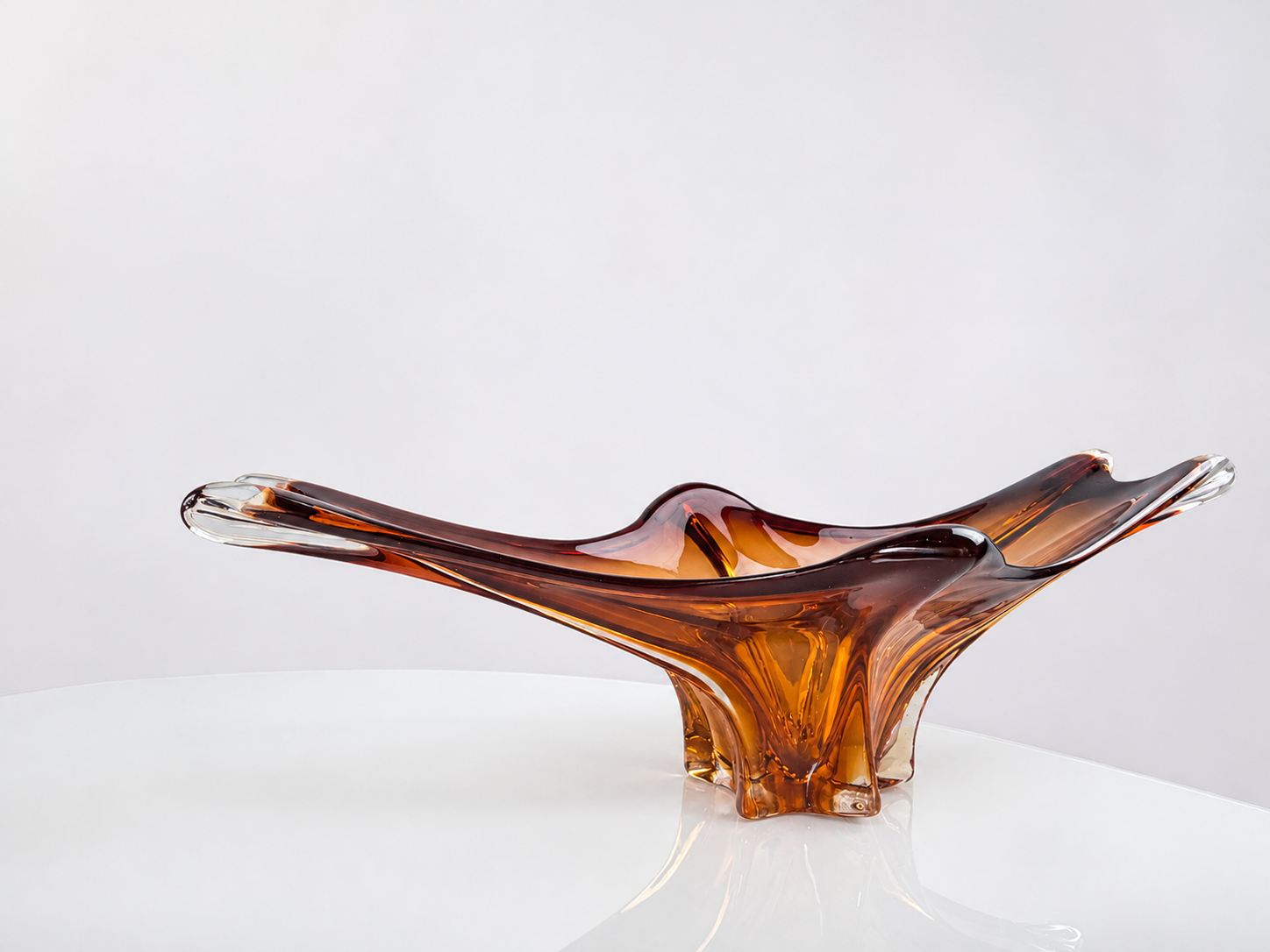
The centre of table Wings, belonging to the Acervo, approximates this history of material experience. Its sheet describes layers of amber and smoke suspended in transparent glass and asymmetrical form, identifying it as submerged glass and placing it in Italy, approximately between 1960 and 1970. This date and origin belong to the catalogue record of the specimen; they do not constitute, by themselves, assignment to a specific designer or oven.
The analysis of a piece begins with the basis, traces of manufacture, the construction of layers and by marks or labels that may be preserved. Weight, brightness and sound are not enough to identify the chemical composition; a polished base does not authenticate a source. The Archaeology of Matter requires to approximate these observations of verifiable documentation. The Memory of Matter also considers the uses and circulation that begin to integrate the biography of the object.
Between Venice, Bohemia and Brazil, the color inside the glass reveals different technical stories. Recognizing these differences allows to observe the work of the glassmakers and the identity of each manufacture without transforming formal similarity into authorship or origin.
Related readings
Documents and pages of the Acervo used as an editorial or in-depth basis. Do not replace catalogues of manufacturers and primary sources when required by historical identification.
- Corning Museum of Glass — Sommerso Vase (1951)Seguso Vetri d'Arte; probable authorship of Flavio Poli and Mario Pinzoni.
- Corning Museum of Glass — Josef Hospodka (1958)A museum example of Czechoslovak glass tradition.
- Corning Museum of Glass — František Vízner (1967)Example of artistic glass from Škrdlovice.
- St Mark's Crystals — Company HistoryInstitutional source on Aldo Bonora and the Molinari brothers.
- Cá d'Oro crystals — HistoryInstitutional source on Mario Seguso, the Ferro brothers and the foundation in 1965.
- Region of Veneto — Murano Art GlassOfficial documentation of the geographical collective mark.
Objects related to this research
Wings · Sommerso Glass Centerpiece
Italy • c. 1960–1970
Amber and smoke layers suspended in transparent glass in asymmetrical gestures.
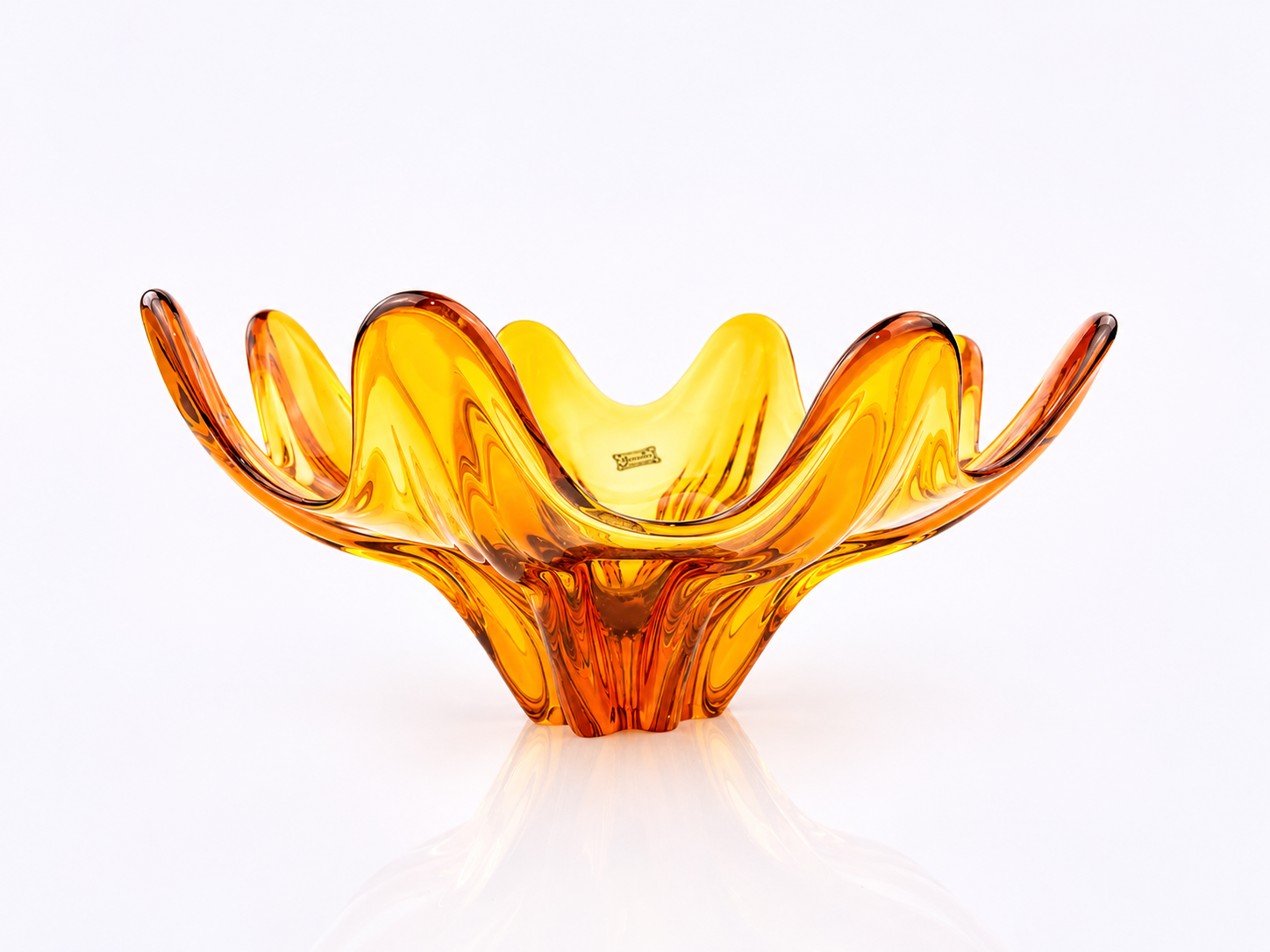
Egermann · Bohemian Centerpiece
Czech Republic • End of 20th century
Amber glass table center with a sculptural organic shape.