WMF and Eberle: Why do two candlesticks seem so close?
The similarity between WMF and Eberle pieces opens an investigation into design, industry and the brands that have crossed the 20th century.
Pesquisa e curadoria: Jorge Feitosa e Fábio Garcia
Jorge Feitosa percebeu a semelhança entre dois candelabros: um WMF alemão de sua coleção particular e um Eberle de três luzes registrado no histórico do Acervo. Os braços curvos e a proporção dos bocais aproximam as silhuetas, mas as marcas apontam para fabricantes com trajetórias próprias. A comparação percorre a metalurgia da Alemanha e de Caxias do Sul sem transformar uma semelhança de desenho em prova de cópia.
What the eyes are approaching
Curved arms, circular base and high sail supports appear in various combinations in decorative metallurgy of the twentieth century. The repetition of these elements makes the design of candlesticks produced in different countries familiar.
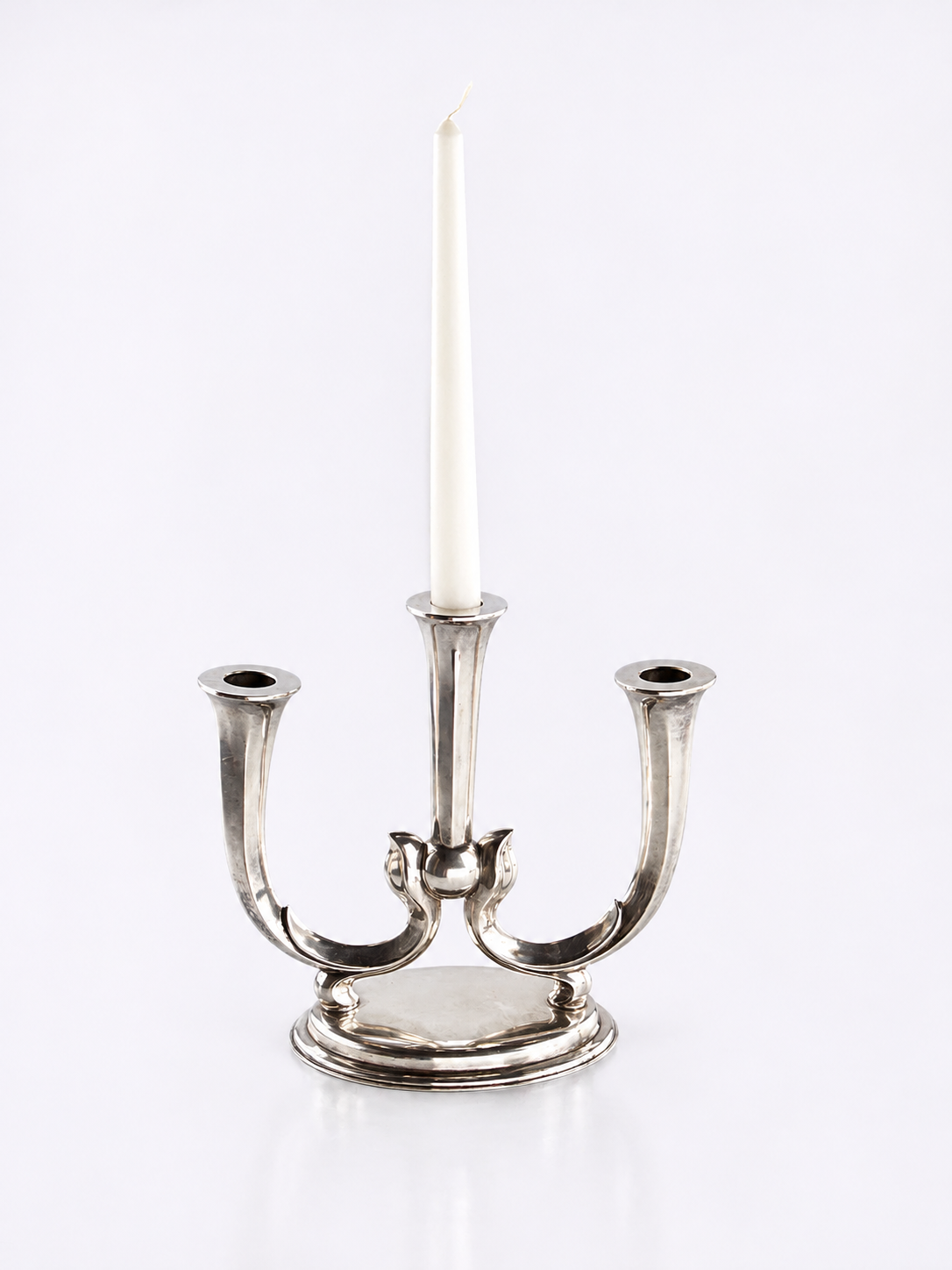
The two examples that gave rise to the comparison are the WMF candlestick preserved in the curators' personal collection and the Eberle of three lights shown in the photograph of this chapter. In the Brazilian piece, the high central stem combines with two curved arms and a circular base. The similarity between silhouettes invites comparison; the way of construction and the treatment of details help to understand the differences.
A photograph brings the silhouettes closer together; close by, the frames, jars and bases reveal their own manufacturing solutions. It is these details that make the comparison between the two objects interesting.
WMF: from Geislingen to the table
WMF's trajectory began in 1853, in Geislingen, Germany, with the Straub & Schweizer metal factory. In 1880, the union with another company gave rise to Württembergische Metallwarenfabrik, a name that would be abbreviated as WMF.
The company has crossed different drawing languages and has assembled a wide production of tableware and decorative metal objects. Its historical archive, preserved in Geislingen, contains about 11,000 copies, among production pieces, studies and prototypes. For the history of design, this collection allows to follow changes in form, technique and use over generations.
Catálogos históricos mostram como a WMF oferecia desenhos muito variados a seus compradores. A circulação não ficou restrita à Alemanha: Vera Grieneisen, em tese apresentada à UFRGS em 2019, registra que artigos da fábrica eram exportados em grandes quantidades também para o Brasil. Essa informação ajuda a situar a presença de peças alemãs nas coleções brasileiras, mas não estabelece a trajetória do candelabro específico que motivou esta comparação.
Eberle: an industry built in South Caxias
In 1896, Abram Eberle took on a small funeral workshop in Caxias do Sul. The first activities were linked to the manufacture of utility objects, such as lamps. In 1918, the company began producing cutlery, cutlery and tableware. The workshop became, throughout the 20th century, a metallurgical industry of great diversity.
This production also entered the material history of Brazilian houses. A fork attributed to Eberle, for example, integrates the collection of the Santa Casa de Porto Alegre Historical-Cultural Center. It is a museum record of how metallurgical objects circulated beyond the factory and remained preserved.
Ricardo da Silva Mayer studied the ornamentation of Eberle silver knives from historical catalogues. His research shows how European repertoires were adapted in Brazilian production. It is a useful context to understand the choices made by metallurgical artists from Caxias do Sul.
How a drawing crosses borders
A volute arm, a raised rod or an open mouthpiece can recall objects from different times and places. In the world of decorative metallurgy, these solutions included repertoires that circulated through catalogues, exhibitions, workshops and commercial contacts.
A Eberle enviou dirigentes aos Estados Unidos e à Europa nas décadas de 1920 e 1930 para conhecer técnicas e equipamentos. O Instituto Bruno Segalla documenta outra face desse intercâmbio: na seção de gravação da metalúrgica, Segalla operava um pantógrafo importado da Alemanha e trabalhava com moldes de decoração para objetos de metal. O repertório formal e os meios de produção podiam circular por caminhos diferentes.
Ter acesso a máquinas e dominar o trabalho com matrizes não comprova que a Eberle tenha adquirido moldes da WMF. Até aqui não foi localizada documentação de uma compra ou transferência desse tipo. A comparação entre as duas marcas continua a exigir catálogos dos modelos, marcas, proporções e detalhes de construção dos candelabros.
Os arquivos empresariais podem acrescentar elementos à pesquisa. Cartas, livros contábeis e catálogos históricos da Eberle foram encaminhados ao Arquivo Histórico Municipal João Spadari Adami, em Caxias do Sul; o Wirtschaftsarchiv Baden-Württemberg preserva documentação da WMF. São caminhos para investigar possíveis relações, não uma prova de que elas ocorreram.
Two marks, two paths
The inscriptions on the base of an object usually change the direction of the investigation. WMF used different versions of its brand throughout its history, including the figure of an ostrich. Eberle adopted in 1908 a symbol known as a pitier, inspired by a small cigarette accessory whose shape reminded a trumpet.
WMF ostrich and Eberle's pitière are part of graphic identities of different times and places. In the casticials, the brand finds other signs of manufacture: the treatment of the silver surface, the laces and the design of the base.
When these elements are seen together, the brand gains context. The inscription on the base and the shape of the object count complementary steps of the industrial trajectory.
The meeting at the Acervo
WMF brings together a chapter in German metallurgy; Eberle, a Brazilian industrial history linked to Caxias do Sul. The Acervo approaches both for a visible characteristic: the design of the arms and the proportion of the chandeliers.
The comparison began with a WMF of the curators' personal collection, which was never available for purchase, and the Eberle of three lights recorded in the Acervo's history. The similarity led Jorge and Fabio to investigate the trajectories of the two companies.
The personal WMF is distinct from the modular candlestick of one or three lights available in the catalogue. Similarly, the Eberle compared here is the example of three lights, and not the pair of Eberle candlesticks also registered in the Acervo.
A comparação começa nos braços curvos e na altura dos bocais, mas também exige olhar as bases, os encaixes e as marcas. O exemplar WMF da coleção particular não é o mesmo candelabro WMF disponível no catálogo, assim como o Eberle comparado não deve ser confundido com outros modelos da fábrica.
Without catalogues identifying the two models and their chronology, there is no basis to say that one company copied the other. Comparison is valuable because it makes the circulation of shapes visible in decorative metallurgy.
Related readings
Documents and pages of the Acervo used as an editorial or in-depth basis. Do not replace catalogues of manufacturers and primary sources when required by historical identification.
- WMF — Our HistoryOfficial chronology: Straub & Schweizer in 1853, WMF formation in 1880 and preservation of the archive of approximately 11,000 objects in Geislingen.
- Eberle — HistoryTimeline of the company of Caxias do Sul: beginning in 1896, production of tableware in 1918 and metallurgical expansion.
- Ricardo da Silva Mayer — Eclecticism in the ornamentation of silver knives produced by Metallurgical Abramo EberleAn academic study based on catalogues and copies of Eberle knives. It bases the discussion of ornamental repertoires and circulation of techniques, but does not identify the model of these candlesticks.
- Historical-Cultural Centre Santa Casa de Porto Alegre — Eberle dessert forkMuseum record of Eberle object preserved in institutional collection.
- Pioneer / GZH — Eberle Center, a corner and a pitierHistory of the piteira brand, adopted in 1908, with reference to the historical documentation of the company.
- Opinion Jorge Feitosa — WMF, One or Three-Lume Modular CandlestickAnother WMF piece from the catalogue, available for purchase and distinct from the sample of the personal collection that motivated this research.
- Acervo Jorge Feitosa — Eberle, Candlestick of Three LightsEberle candlestick record of three lights that participates in the comparison and provides the cover photograph.
- Vera Grieneisen — Aspectos trans-culturais na arquitetura porto-alegrense, UFRGS, 2019Na p. 61, a autora documenta exportações expressivas da WMF ao Brasil; não identifica o modelo ou a proveniência do candelabro do Acervo.
- Instituto Bruno Segalla — O ArtistaDocumenta o uso de pantógrafo importado da Alemanha e o trabalho com moldes de decoração na Eberle; não documenta compra de moldes WMF.
- Pioneiro / GZH — Acervo da Eberle é doado ao Arquivo Histórico, 2016Identifica acervo empresarial Eberle com cartas, contabilidade e catálogos no Arquivo Histórico de Caxias do Sul.
- Wirtschaftsarchiv Baden-Württemberg — WMF AG, arquivo B70Registro institucional do fundo WMF de 1853 a 2006, com catálogos e documentação empresarial. Não comprova vínculo com a Eberle.
Objects related to this research
Eberle · Three-Light Candelabrum
South Caxias, RS • 20th century
Silver metal with high central rod and curved arms in classic symmetry.
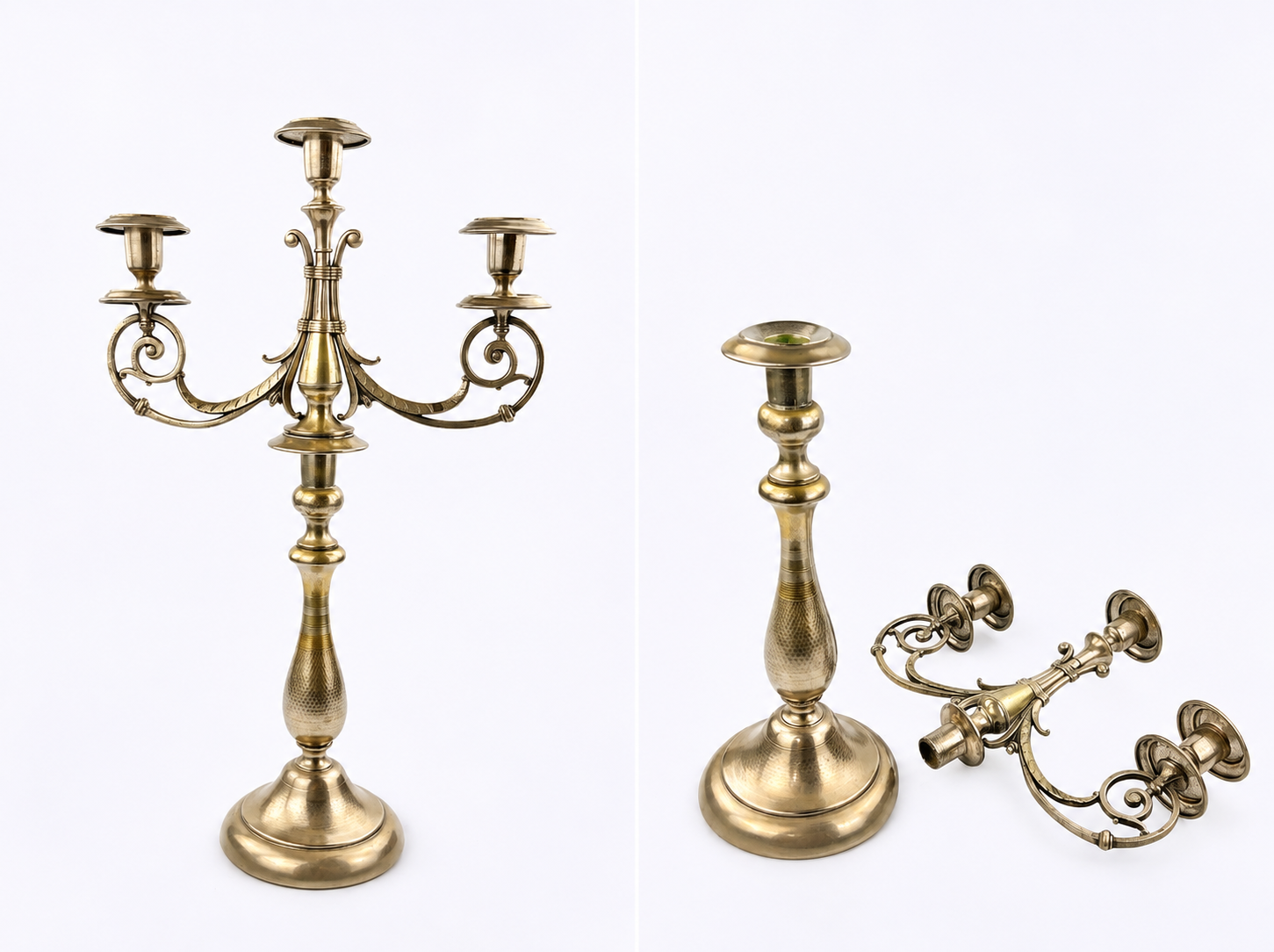
WMF · Modular One- or Three-Light Candelabrum
Germany • 20th century
Candlestick with removable arms, shown in the photograph in the settings of one and three lights.
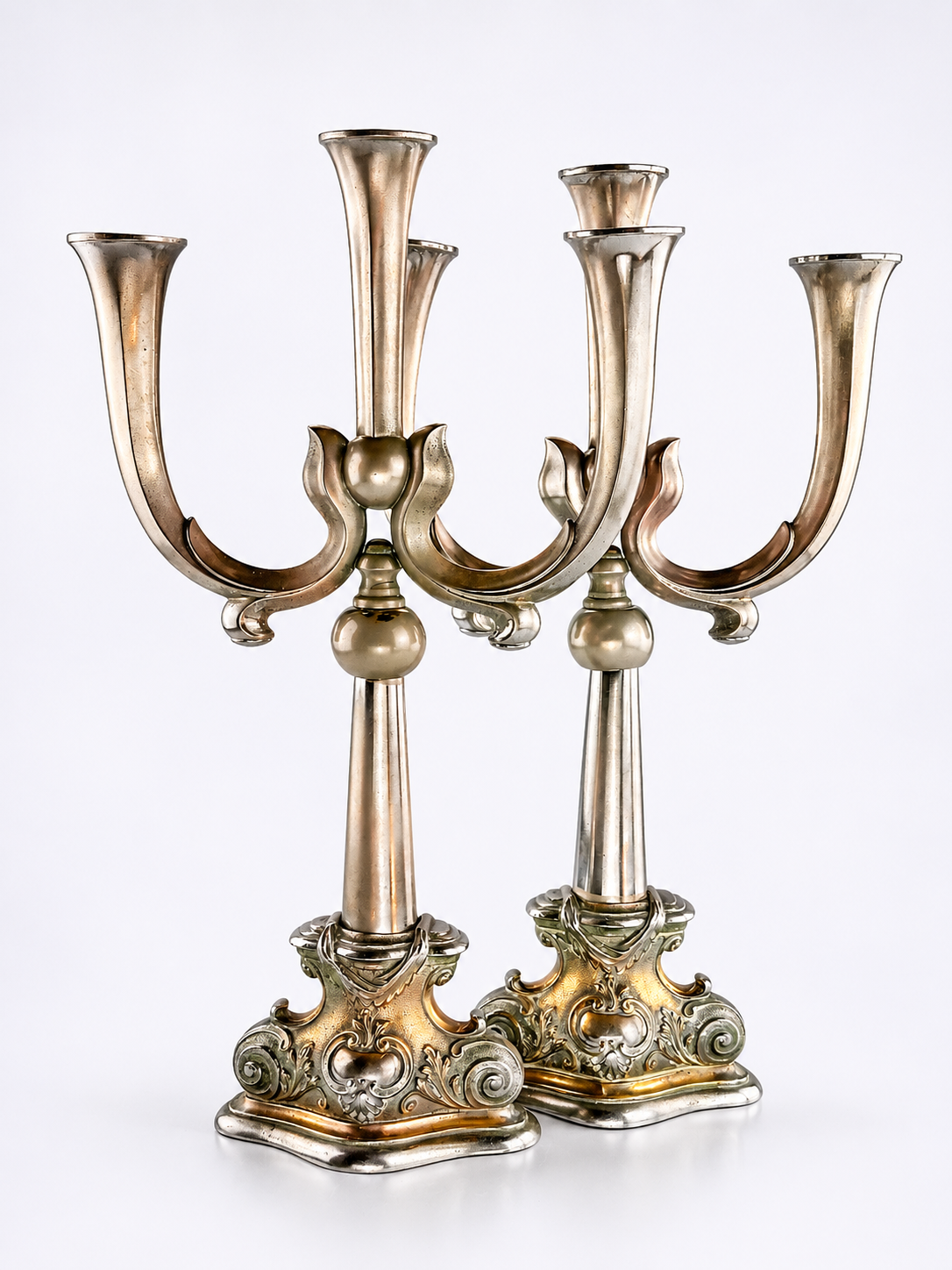
Eberle · Pair of Three-Light Candelabra
South Caxias, RS • 20th century
Silver metal pair, with high rods, curved arms and base in volutes.
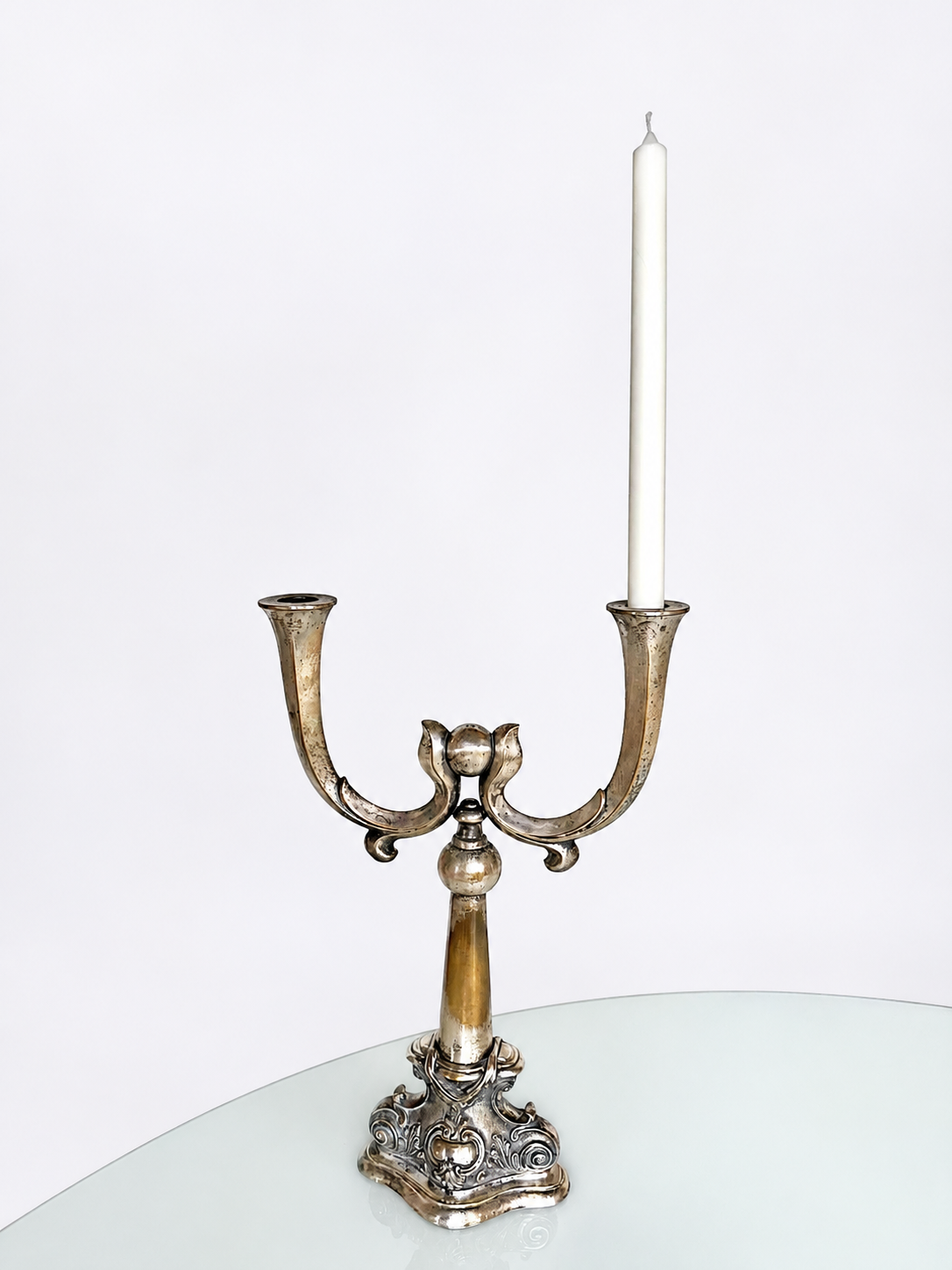
Eberle · Two-Light Candelabrum
South Caxias, RS • 20th century
Silver metal candlestick, with two curved arms and a raised ornamented base.