Hermès Pied de Chevreuil: When the hunt reached the table
Hermès salad cutters, hunting iconography and an auction record that helps investigate the Chevreuil Foot motif.
Pesquisa e curadoria: Jorge Feitosa e Fábio Garcia
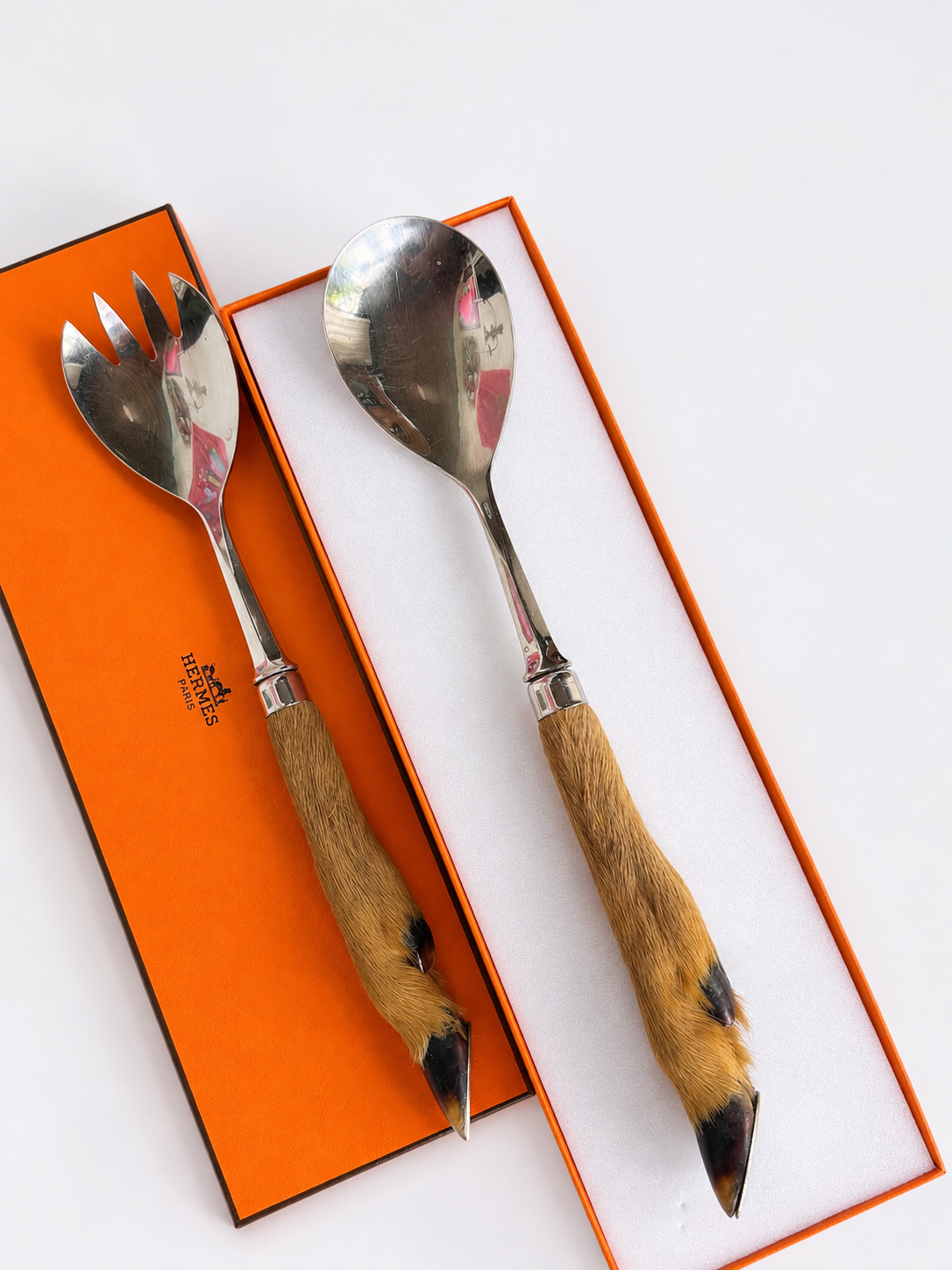
Os cabos de um par de talheres de salada Hermès terminam em patas de cervídeo, um motivo que traz a iconografia da caça para a mesa. O conjunto Pied de Chevreuil do Acervo Jorge Feitosa conserva seu estojo. A pesquisa encontrou em um leilão da Bonhams um abridor de cartas com o mesmo nome, datado de cerca de 1957. É uma pista para a história do repertório decorativo, não uma data comprovada para estes talheres.
Before the bags, the horses
In 1837, Thierry Hermès opened a workshop in Paris dedicated to the manufacture of harnesses and equipment for horses.
The reputation of the house was initially built in this universe. The saddlery required knowledge of materials, resistance of the pieces and attention to execution. Its customers belonged to a society in which horses still had importance in transportation and leisure activities.
Hermès expanded its production over time. Travel items, personal accessories and objects came into the house.
Equestrian references remained, accompanied by images of other animals associated with life in the field and European traditions.
It's in this repertoire that we found the Chevreuil Foot.
When the hunt was part of the decoration
For centuries, hunting was linked to the life of European rural properties. In certain aristocratic circles, it also represented a social activity, surrounded by customs, equipment and codes of its own.
This culture left marks on the decoration. Deer appeared in tapestry and porcelain. Horns were incorporated into household objects. Hunting dinners occupied paintings, table services and personal accessories.
The presence of these motives continued in the twentieth century, even when many objects were already circulating far from the environments in which those traditions had arisen.
Hermès cutlery belongs to this visual universe. The name Chevreuil's Foot, literally .skin of the harrow, reveals the reference that guides his drawing. The animal motif was incorporated into a pair of serving utensils, intended to occupy the table during meals.
It is a choice that draws attention precisely to the function of the object: a symbol associated with hunting appears in a tool used to serve salad.
A discovery at a bonhams auction
When we searched the whole thing, we found a record that expanded its history.
In October 2023, Bonhams presented, at an auction dedicated to the Hermès collection of Geneviève Fontan, a letter opener identified as Coupe-paper Pied de Chevreuil.
The object was classified as Hermès Paris, approximately 1957. At 36 centimeters in length, it was described as an aluminum part and a deer paw.
The most interesting detail is in the name. Chevreuil's foot also appears in an office accessory, showing that this reference was not restricted to tableware.
The letter opener and the cutlery belong to different functions, but share a language linked to the same animal universe. The Bonhams record also offers a period reference to investigate this Hermès repertoire.
The research revealed other accessories of the house with motifs of horses, birds and dogs. Some were produced by Ravinet d .Enfert, French manufacturer associated with the production of metal articles.
These pieces help to place the whole within a wider production of Hermès accessories in the mid-20th century.
A Model That Asks Comparison
Finding another pair of Chevreuil Foot cutlery has been a difficult task.
In the research carried out by the Acervo, Hermès accessories with animal references, salad cutlery of other types and the letter opener presented by Bonhams were created. Similar examples to the set, however, remain poorly documented in the localized records.
The comparative documentation is still limited, which makes it especially useful to preserve photographs of the case and the details of the set. We know that the motif has circulated in different Hermès objects, but we still do not find documentation that establishes how many pairs of cutlery have been manufactured.
The Acervo set also preserves its case, an important element to understand its original presentation and compare future model records.
What changed was our look.
Perhaps the most interesting question about the Chevreuil Foot is the way we observe it today.
For the part of the mid-20th century public, references to hunting could evoke life in the countryside, certain social customs or a family decorative tradition.
The same image can raise other questions at present. The relationship with animals, the origin of the materials and the values associated with hunting have become a different space in the discussions on consumption and culture.
This does not mean that all people thought the same way in the past, nor that there is today a unique interpretation. It means that objects continue to be seen by people of different times.
A form that could appear familiar before now can cause discomfort or curiosity, and this change is also part of your history.
What remains
The Chevreuil Foot retains its original function: serving at the table. It also retains the animal reference that guided its design.
But its presence in the Acervo allows to look beyond use. There is the history of Hermès and its origins in the saddlery. There is the permanence of hunting as the theme of the decorative arts. There is a letter opener, dated about 1957, which helps to reconstruct the circulation of this motif.
O motivo Pied de Chevreuil também desperta uma pergunta de pesquisa: quando e em quais objetos a Hermès o utilizou?
O conjunto preserva a referência ao universo equestre e à caça que atravessou parte das artes decorativas europeias. Hoje, a forma dos cabos chama a atenção como desenho, enquanto o estojo e as inscrições ajudam a examinar sua identificação.
O abridor de cartas documentado pela Bonhams situa o motivo em outro tipo de acessório, mas ainda faltam registros que determinem com precisão a data de fabricação destes talheres.
Servir uma salada com cabos em forma de patas de cervídeo é encontrar um detalhe ornamental onde normalmente se espera apenas uma função. O par Hermès do Acervo conserva esse encontro entre desenho figurativo e objeto de mesa.
Related readings
Documents and pages of the Acervo used as an editorial or in-depth basis. Do not replace catalogues of manufacturers and primary sources when required by historical identification.
- Bonhams — L ̈Art du Luxe: Hermès, Geneviève Fontan collection, 30 October 2023, lot 235. Hermès Paris, approx. 1957, Coupe-papier Pied de Chevreuil.Documental reference to the letter opener, not proven date of the pair of cutlery.
Objects related to this research
Hermès · Pied de Chevreuil Salad Servers
France • 1950s
Pair of salad cutlery Chevreuil Foot, composed of spoon and fork, accompanied by a case.