
Eberle: The hidden work in 12 centimeters
A jewelry rack from the mid-20th century brings birds and roses together and reveals a chapter in the history of Brazilian metallurgy.
Pesquisa e curadoria: Jorge Feitosa e Fábio Garcia
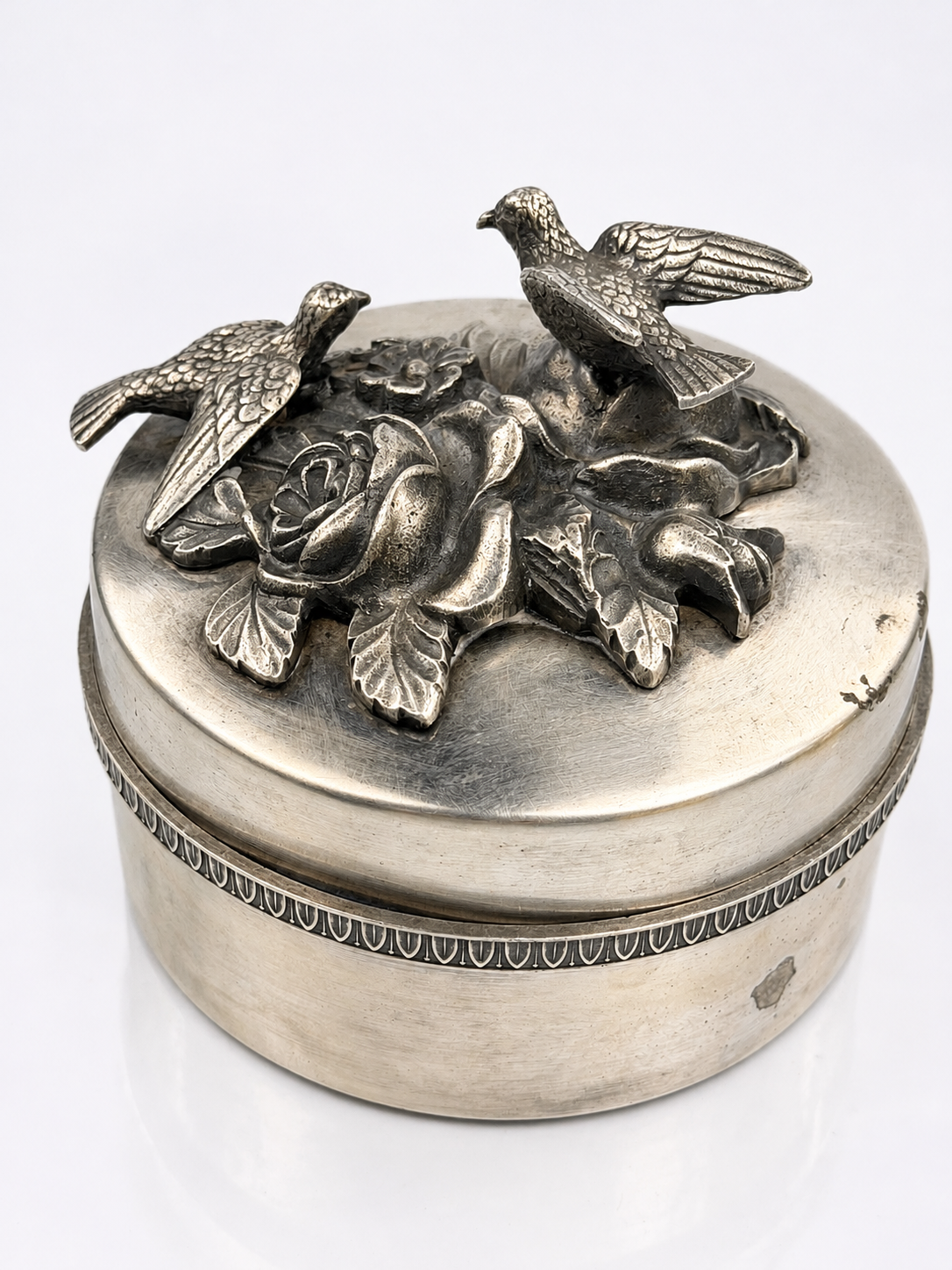
É preciso chegar perto para perceber tudo o que cabe na tampa deste porta-joias Eberle. Em aproximadamente 12 centímetros, aves, rosas e folhagens surgem em diferentes planos do metal prateado. O objeto do Acervo Jorge Feitosa leva à história de uma metalúrgica de Caxias do Sul e mostra como o desenho ornamental participava também dos pequenos artigos feitos para a casa.
From a funillary to Brazilian industry
In 1896, at the age of 16, Abram Eberle took over the small funeral home of his family in Caxias do Sul. He had learned the trade from his mother, Luigia Zanrosso Eberle, known as Gigia Bandera, who participated in the workshop.
Among the first products were the lamps, made to meet the needs of a region in transformation. The metal was worked to produce everyday objects, in an activity that combined practical knowledge and manufacturing solutions.
The expansion came in the following decades. In 1918, the company began manufacturing cutlery, cutlery and tableware. Its production was diversified to include household items, religious articles, medals, tools and other metal products.
In the first half of the 20th century, Eberle was already in an important position in the Caxias do Sul industry. Its articles were circulating in Brazil and in markets in neighbouring countries, following the growth of consumption of industrial products.
This trajectory can also be counted by objects that entered the houses. In addition to the utensils necessary for daily life, there were pieces designed to adorn the environments and accompany personal habits.
The jeweller of the Acervo belongs to this dimension of Eberle production.
The taste of ornament
The lid concentrates almost the entire visual expression of the piece.
Birds, roses and foliage appear at different heights, forming a small sculptural composition. Metal accompanies the contours of the figures, while the reentrances create shaded areas that help separate the elements.
There is an evident drawing work in this organization. In ornamented metallic objects, details need to retain their definition throughout the manufacture and finishing. On such a small surface, the loss of sharpness of a leaf or petal can modify the reading of the set.
Ornamentation also allows to approach the jewellers of a tradition present in Brazilian production since the end of the 19th century.
In studying Eberle's silver knives, researcher Ricardo da Silva Mayer identified the continuity of ornamental repertoires of European origin, later adapted by local production. His research shows how the Brazilian industry incorporated these references and developed solutions for his articles.
Flowers, volutes and figurative elements circulated through different categories of objects, from tableware to personal accessories. The persistence of this vocabulary helps to understand why a piece produced in the mid-20th century could present such elaborate decoration.
In the jewelry rack, the interest is in the way the ornament occupies the lid and changes the perception of a small and functional container.
Birds and roses: a decorative choice
The association between birds and flowers has a long presence in the decorative arts. These motifs appear in porcelains, embroidery, metal objects and other articles intended for domestic interiors.
In different traditions, birds and roses received interpretations related to affection, nature and life. But the same reasons were also used simply for their ornamental possibilities.
In the Eberle copy, there is no known documentation that allows to attribute to the figures a specific symbolic meaning. What we can observe is the choice of gathering elements of nature in an object intended to keep personal belongings.
The function adds an interesting dimension to the drawing.
Jewelry holders usually occupy spaces close to the intimate life of their owners. They are containers for rings, pins, small souvenirs and other objects chosen to remain kept.
The contrast between the small size and the elaborate decoration suggests the attention given to a category of objects that rarely occupied the center of the environments, but participated in everyday habits.
The surface and the weather
Another detail deserves attention: the darkened areas of metal.
In the reentrances, darkening makes the shadows more noticeable and helps to highlight the volume of birds and flowers. In the outgoing parts, the silver surface reflects the light in a different way.
This contrast is part of the present appearance of the piece. The original finish and the changes that have occurred over time need to be considered separately, but both influence the way we perceive the reliefs today.
The patina also raises a recurring question in the preservation of ancient objects: how far should a surface be cleaned to regain its brightness?
There is no unique response for all materials and conservation states. In the case of this jewelry rack, the visual interest of darkened areas shows why any intervention requires attention to the characteristics of the piece.
It is in this aspect that the Memory of Matter finds a concrete expression. Surface changes are part of the physical trajectory of the objects, even when we do not know the people who used them.
A small piece of industrial history
The Eberle signature is one of the elements that allow us to approach this jeweller of the Brazilian production of the twentieth century. Its ornamentation adds another dimension to the research: the presence of figurative design in metallic articles manufactured for everyday life.
Behind the piece is the trajectory of a family workshop that grew with the industrialization of Caxias do Sul, incorporated new techniques and began to produce a variety of objects destined for Brazilian houses.
The scale may be the most surprising aspect. It is about 12 centimeters, occupied by a composition of birds and flowers that remains legible decades after its manufacture.
In observing these details, we found a history of Brazilian design that was also built on household utensils, personal accessories and small ornamental objects.
No porta-joias, o interesse aparece primeiro na tampa: uma cena de aves e flores comprimida em poucos centímetros de metal. A marca Eberle acrescenta a história da fabricação brasileira. Vale observar os relevos de perto para perceber o desenho que uma fotografia geral nem sempre mostra.
Related readings
Documents and pages of the Acervo used as an editorial or in-depth basis. Do not replace catalogues of manufacturers and primary sources when required by historical identification.
- Eberle — HistoryInstitutional chronology: origin of the workshop in 1896 and beginning of the manufacture of cutlery and tableware in 1918.
- Ricardo da Silva Mayer — Eclecticism in the ornamentation of silver knives produced by Metallurgical Abramo Eberle: a preliminary studyStudy on the ornamental repertoires employed by Eberle. It does not attribute the design or the specific technique of this jewelry rack.
- Imperial Museum — Record of Medal produced by Metallurgical Abram EberleBiographical and historical reference to the family and the company; it is not registered in this jewelry rack.
- Opinion Jorge Feitosa — Porta-Joias Avifauna e RosasCatalogue file of the specimen, with main photograph, approximate date and description of the silver metal.
Objects related to this research
Eberle · Jewelry Box with Bird and Rose Motifs
South Caxias, RS • c. 1950
Silver metal with sculptural lid formed by birds, roses and foliage.
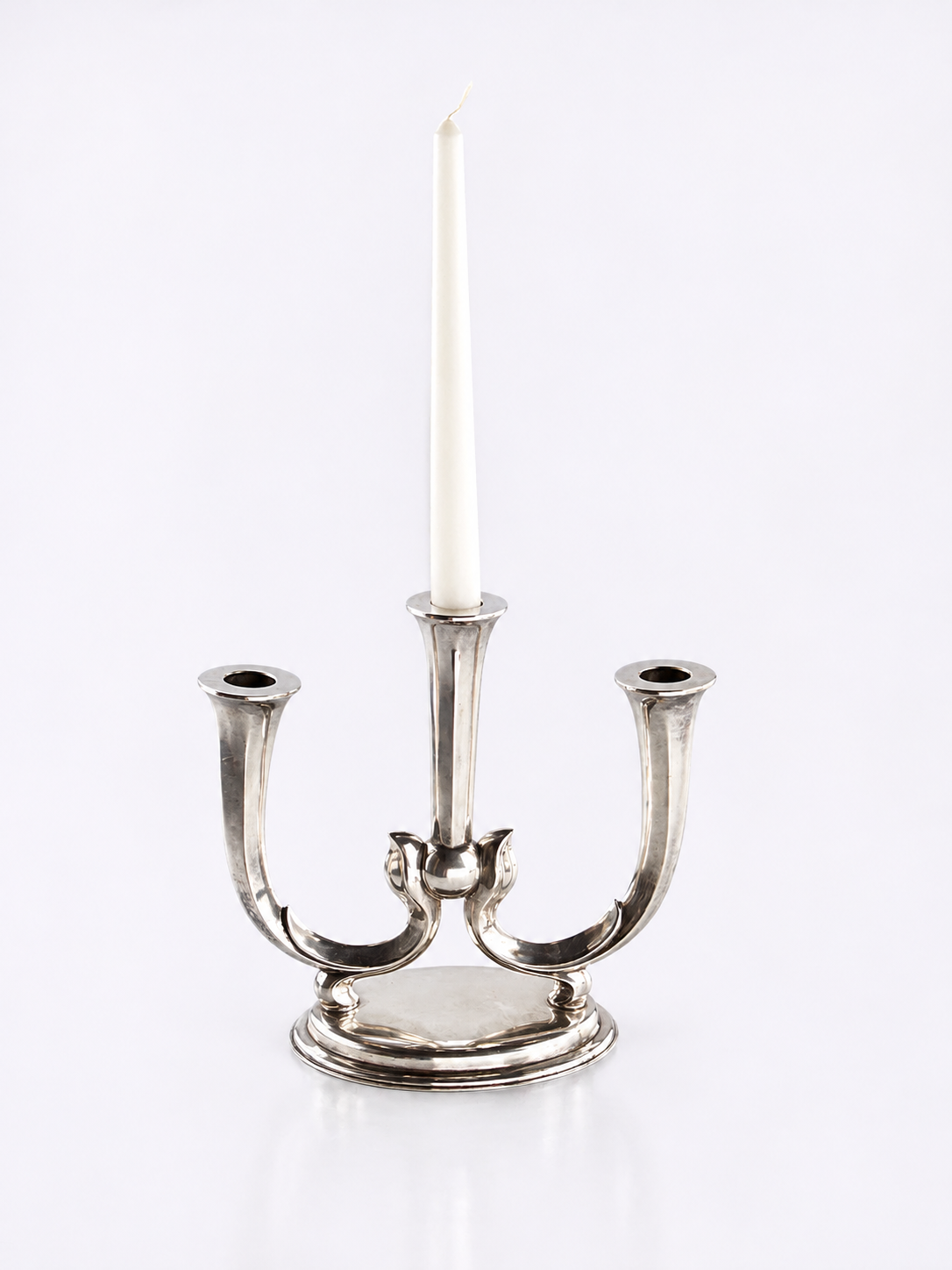
Eberle · Three-Light Candelabrum
South Caxias, RS • 20th century
Silver metal with high central rod and curved arms in classic symmetry.
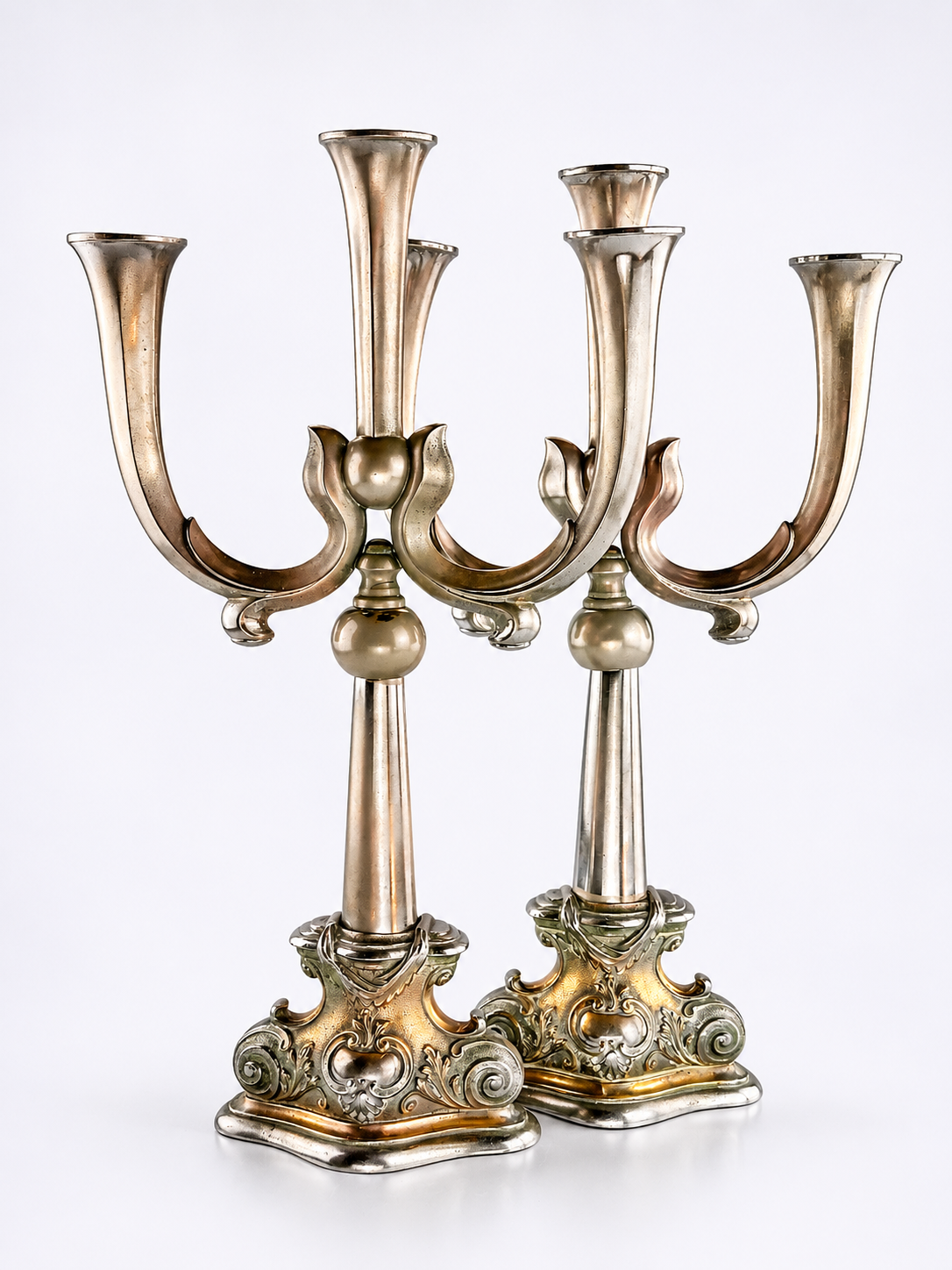
Eberle · Pair of Three-Light Candelabra
South Caxias, RS • 20th century
Silver metal pair, with high rods, curved arms and base in volutes.
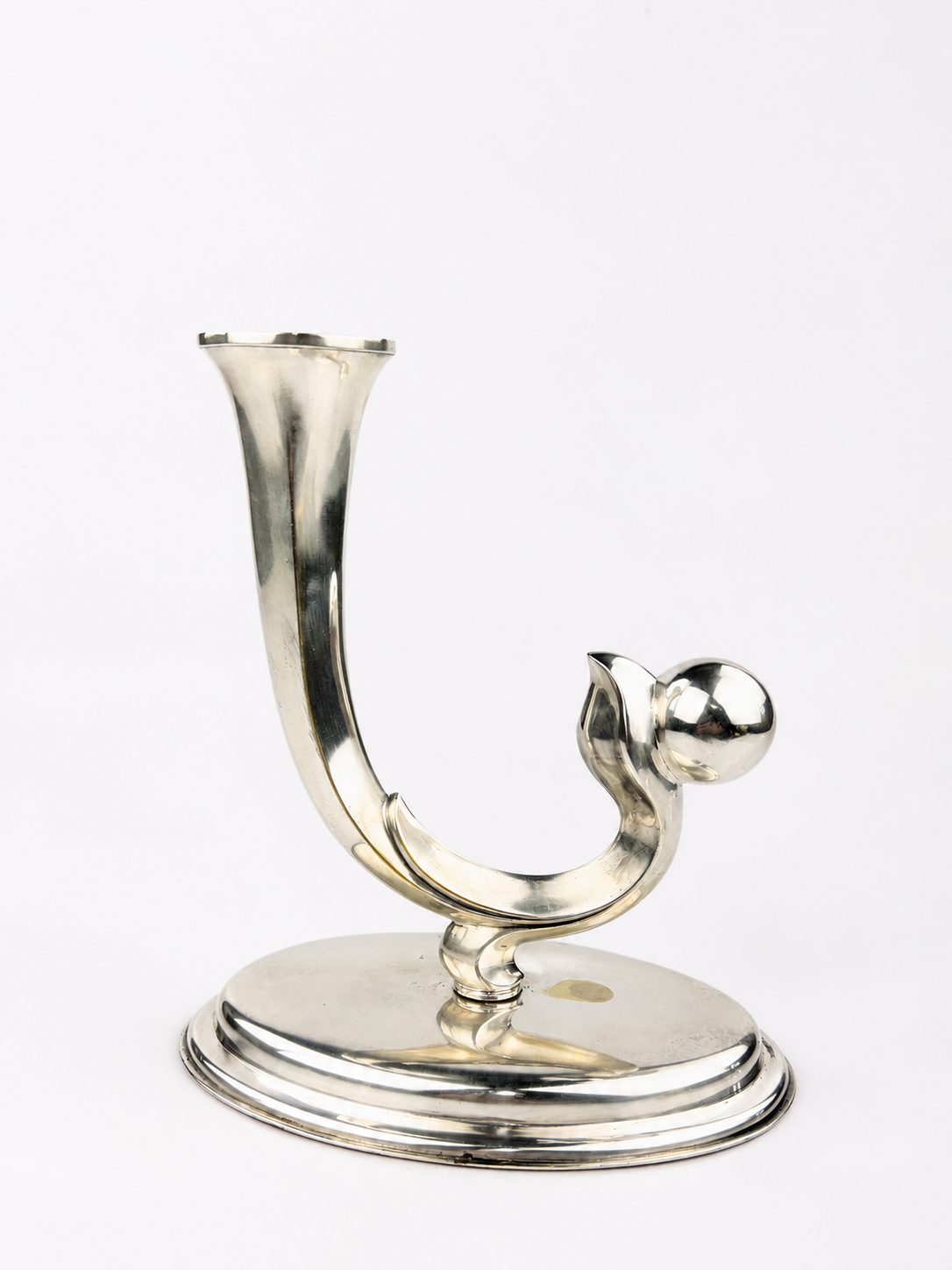
Eberle • Art Deco-Style Candlestick
Brazil • 20th century • Silver-plated metal
Single-light Eberle candlestick with a curved stem, spherical terminal and stepped oval base. Its Art Deco-inspired design emphasises continuous lines and reflective surfaces.