
Cornucopia: Brazilian ceramics that came home
Found in the United States, a 20th century Brazilian piece gained a new stage of its circulation when it returned to the country.
Pesquisa e curadoria: Jorge Feitosa e Fábio Garcia
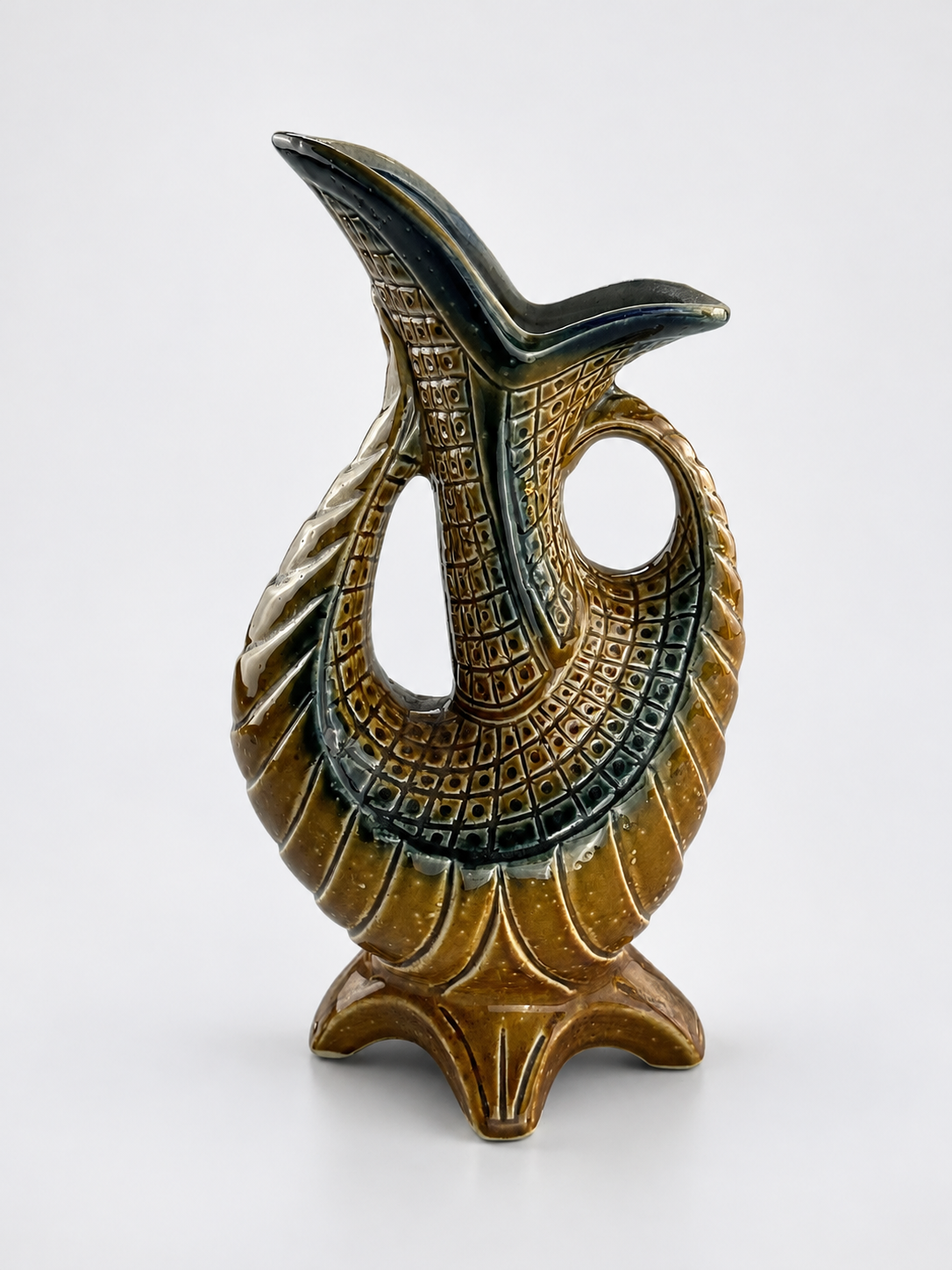
Foi nos Estados Unidos que Jorge Feitosa encontrou esta cornucópia de cerâmica, com abertura assimétrica, vazados laterais e relevos geométricos. Ao virar o objeto, viu a inscrição “Brasil”. O encontro levou à decisão de trazê-lo de volta ao país. A marca indica a origem declarada na peça, mas não identifica sozinha sua manufatura; a história conhecida começa pelo olhar de Jorge e pela viagem de retorno.
Attend the curators' interviewJorge Feitosa and Fábio Garcia report the match of the play in the United States and its return to Brazil.
Recognition Far From Home
During a trip to the United States, visual artist Jorge Feitosa found a piece of ceramic whose shape and finish seemed to him Brazilian. The asymmetric opening, the lateral leaks and the surface of geometric reliefs drew his attention. According to the curators' report, when turning the object found the inscription . .Brazil .
The inscription confirmed the origin indicated by the play itself and motivated the decision to bring it to the country. The episode was told by Jorge Feitosa and Fábio Garcia in public conversation at Mata Lab and integrates the known circulation of the copy.
The Long History of Cornucopia
Cornucopia, of the Latin cornu copy, or horn of abundance, is a reason for classical iconography. The representation of horn full of fruits and flowers became associated with prosperity and crossed the production of ornamental objects at different periods.
In the cornucopia of the Acervo, the tradition of the horn of abundance appears in the form of a sculpture vessel. The irregular opening, the lateral leaks and the surface of geometric reliefs approximate an ancient reference of the Brazilian decorative repertoire of the twentieth century.
Brazilian production and circulation
The cornucopia of the Acervo is a Brazilian enamel ceramic of the mid-20th century. The asymmetrical shape and textured surfaces approach the part of solutions present in the national decorative production of that period.
Found in the American market, cornucopia returned to Brazil by the curators. The inscription at the base and the episode of the acquisition are parts of this circulation, preserved in the report of Jorge and Fábio.
The return as a new layer of biography
When telling about the discovery in public conversation, the curators raised a question about how Brazilian ceramics is perceived inside and outside the country. Cornucopia gains another presence when its Brazilian origin is recognized in a foreign market.
The inscription .Brasil . supports the identification of origin indicated in the piece, but does not reveal the manufacturer alone. For Jorge, the episode made visible a recurring question in curatorship: how often do we recognize the value of a Brazilian production only when we find it outside the country? The return began to integrate the biography of this cornucopia.
Related readings
Documents and pages of the Acervo used as an editorial or in-depth basis. Do not replace catalogues of manufacturers and primary sources when required by historical identification.
- Acervo Jorge Feitosa — public conversation with the curatorsTestimony about the discovery on the trip, the Brazil inscription on the base and the decision to bring the piece back.
- Acervo Jorge Feitosa — cornucopia recordIdentification and description of the specimen; Brazilian origin and context of acquisition.
- Museum of Acropolis — CornucopiaIt documents the iconographic motif of the horn of abundance and its meaning.
Objects related to this research
Sculptural Cornucopia in Brazilian Ceramics
Brazil • mid-20th century
Cornucopia in enameled ceramics, with large asymmetric opening, leaked and reliefs. The piece was acquired in the United States and brought to Brazil by the Acervo.