How a resting deer gained space in American decoration
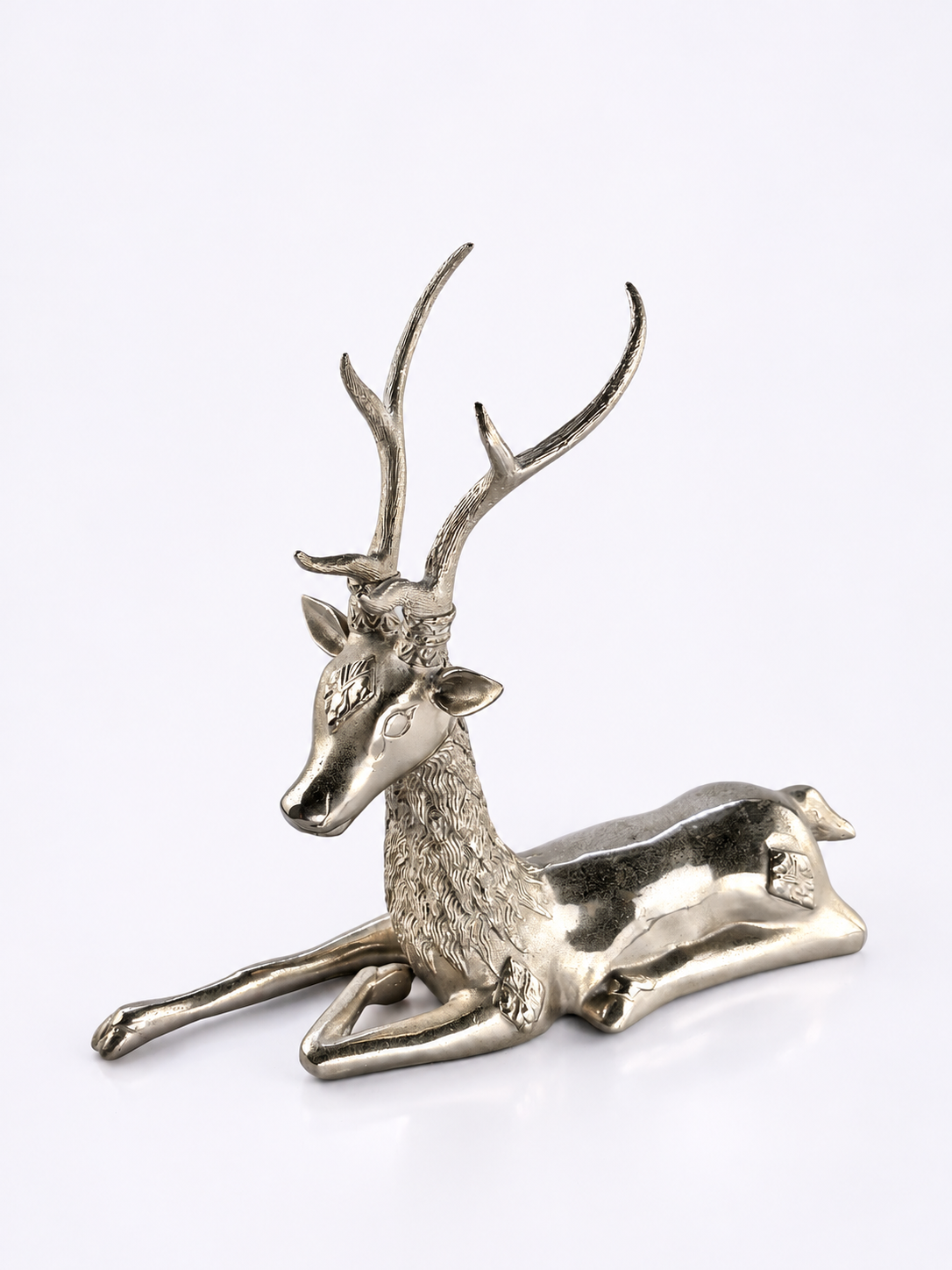
The reclined deer of the Acervo Jorge Feitosa gathers references to Indian artisanal production and the ornamental repertoire that gained space in the interiors of the 20th century.
Pesquisa e curadoria: Jorge Feitosa e Fábio Garcia
Deitado, com as patas recolhidas e a galhada erguida, este cervo ocupa o espaço como uma pequena escultura. A peça do Acervo Jorge Feitosa, apresentada na Mata Lab, chama a atenção pelo contorno e pelo relevo do metal. Sua pesquisa percorre a história da Sarreid, empresa criada em 1967, e a circulação de objetos artesanais na decoração americana, sem atribuir a escultura a uma oficina ainda não documentada.
A trip to Spain gave rise to Sarreid
In 1967, American Alex Sarratt and Walter Reid traveled to Spain looking for antiques to import. They found workshops that produced new objects using knowledge and artisanal processes transmitted between generations.
From this experience, Sarreid Ltd., whose name combines parts of the surnames of its founders.
The first imports included ceramics, wood carvings, leather goods and decorative articles. In 1970, the company opened an office in Italy and expanded its relations with European producers. Subsequently, its catalogue began to collect objects from other countries, including India.
Sarreid has established a commercial model based on the approximation of artisanal production with the American decoration market. Objects designed in different contexts have become part of residential environments in the United States.
The Deer and the Language of the American Interiors
In the 1960s and 1970s, American decoration brought together very different proposals. While some residences favoured simple lines and few ornaments, others valued polished metals, reflective surfaces and sculptural objects.
One of the languages associated with this repertoire became known as Hollywood Regency.
The former film actor William Haines was one of his principal representatives. In Sunnylands, the Annenberg residence in California, Haines combined classic references with materials, colors and finishes that gave the environments a strong visual presence.
Animal sculptures found their place in this decorative universe. Deer, antelope and birds appeared in metal, often with stylized proportions and ornamented surfaces.
The reclining deer of the Acervo has characteristics associated with this taste. The elongated galvanized one establishes the height of the piece; the details of the body attract the look to the surface. The sculpture can be observed from different angles, and its profile changes according to the position of the person who contemplates it.
An animal present in different traditions
The deer has a long history in the decorative arts.
In Buddhist tradition, it is associated with the first sermon of Buddha, held in the Park of Deer in Sarnath, India. The Los Angeles County Museum of Art retains a reclined deer sculpture produced in the territory of present-day Thailand between the 7th and 8th centuries, linked to this religious iconography.
In Chinese art, the animal is also associated with prosperity and longevity. The Palace Museum in Beijing documents representations in which deer appear alongside pine trees, mushrooms of immortality and other auspicious images.
These traditions show the permanence of the deer as an artistic motif in different regions of Asia.
Throughout the 20th century, the figure also participated in a commercial repertoire of decorative sculptures produced for Western residences.
Sculpture and space
The reclined shape determines how the deer occupies an environment. The base accompanies the horizontal plane of the trimmer or table, while the trench is projected upwards.
The ornamentation of the body offers another observation scale. View from a distance, the piece stands out by the contour. Close, the details of the surface, the reliefs and the differences of finish appear.
It is this relationship between silhouette and metal work that brings the deer closer to the objects chosen to occupy prominent positions in the interiors.
In the Acervo Jorge Feitosa, the piece integrates the nucleus dedicated to the Bestiário and remains available for acquisition in Mata Lab, in Cidade Matarazzo, São Paulo.
O trabalho do metal merece uma observação tão próxima quanto a silhueta: a modelagem do corpo e os relevos da superfície ajudam a distinguir o exemplar. Para identificar a oficina que o produziu, ainda faltam documentação e marcas verificáveis. A história da Sarreid oferece o contexto de circulação comercial, não uma atribuição automática de fabricação.
The trajectory of Sarreid helps to understand the international circulation of decorative objects in the twentieth century. In the deer of the Acervo, interest begins in the form: the galhada determines the height of the composition, while the surface invites a closer observation. The commercial association and the place of manufacture of the specimen require own evidence.
Related readings
Documents and pages of the Acervo used as an editorial or in-depth basis. Do not replace catalogues of manufacturers and primary sources when required by historical identification.
- Sarreid Ltd. — Our Story: A Timeline of Tradition, Innovation, and CraftsmanshipChronology published by Sarreid: foundation in 1967, trip to Spain and expansion to other producers.
- Sarreid Ltd. — The Legacy of Sarreid: What's in a Brand Name?The founders' report on the origin of the name and trade of objects produced in artisan workshops.
- Sunnylands — New Sunnylands exhibition explores the maximalist approach of William HainesDocumentation of William Haines' role in Sunnylands and Hollywood Regency language in American interiors.
- Los Angeles County Museum of Art — Couchant Deer, 7th–VIIIth centuriesA reclined deer from Thailand, Mon-Dvaravati period, associated with the iconography of the first Buddha sermon in Sarnath.
- The Palace Museum — Eternal Abundance from Heaven: Auspicious Deer ArtifactsMuseological research on the symbolism of the deer in Chinese art, in relation to prosperity and longevity.
Objects related to this research
Reclining Deer
Metal Cast • XXth Century
Indian serene presence destined for the Western market in the Sarreid tradition.